|
Alpha Delta Phi at Cornell - History Page
A Comprehensive History of Alpha Delt Phi
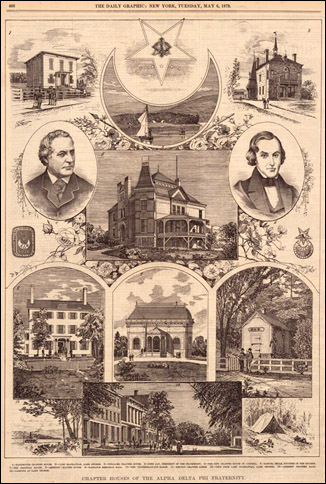
Our Founding It all began rather simply over 170 years ago at Hamilton College, a small liberal arts school in Clinton, New York. It was there that a young student by the name of Samuel Eells, disenfranchised with the offerings and pettiness of the school's two literary societies -- the Phoenix and Philopeuthian -- toiled with the idea of creating a new organization. This organization, according to Eells, “would differ from others” in that it would be built “on a more comprehensive scale than other societies,” would be “national and universal in its adaptations and made a living, growing, self-perpetuating system.” But how could Eells achieve his vision? He'd need some help. “The first step was to select a very few of the most influential members of each literary society, to open to them cautiously the outlines of my plan, and list their co-operation. To my surprise, all approved it, and engaged in the undertaking with the utmost ardor,” Eells later wrote. These influential members, Lorenzo Latham, Henry Lemuel Storrs, Oliver Andrew Morse and John S. Underwood, agreed to meet with Eels on a cold, winter evening in 1831. Under the darkness of night -- only after evening lamps had been lighted -- they congregated in Eells' dormitory room. “Secretly, and without any formal meeting, we pledged ourselves to the work. The first meeting was held at my room, No. 15, Back Middle, Kirkland Hall. All the persons selected were present; but as it was only a meeting for consultation, no presiding officer was appointed and no minutes were taken,” Eells recorded. These were the humble beginnings of our fraternity, Alpha Delta Phi. Eells himself later drew up our Constitution and a golden badge in the shape of a Star and Crescent. Truly, the foundation of the modern Alpha Delta Phi was born -- “a society of a higher nature and more comprehensive and higher principle.” The year was 1832. Meanwhile, not more than 100 miles away in Ithaca, New York, a school founded by Ezra Cornell and Andrew Dickson White opened its doors to students in the fall of 1868. Cornell University, founded on the motto, “I would found an institution where any person can find instruction in any study,” was revolutionary in its aim: to educate its students in any form of knowledge without regard to gender, race, religion or wealth. It was shortly after the University's founding that several national fraternities began taking steps to organize chapters at the new institution. Alpha Delta Phi was one of them. In January of 1869, only six months after students had arrived on East Hill, seven Alpha Delt alumni of other chapters who lived in Ithaca started the formation of our Cornell chapter. These men chose our fraternity's first twelve members: Dewitt Clinton Johnson Bingham '70, Thomas Castle '72, Frederick Lee Gilbert '71, Samuel Dumont Halliday '70, Harvey Judson Hurd '72, Chester Hicks Loomis '72, William Workman Lyon '72, Walter Scott MacGregor '71, George Henry Phelps '71, Morris Morris Ross '70, Henry Hale Seymour '71 and Henry Graves Wells '72. Bingham, originally from Des Moines, Iowa, later became a journalist and editor and was also the U.S. Consul to Aix-la-Chapelle, Germany in 1893. Castle, from Buffalo, New York, pursued a career in jewelry, while Gilbert, a man from Duluth, Minnesota, would work as a lumber manufacturer and shipbuilder. A native Ithacan, Halliday attended Law School and become Tompkins County's district attorney. He also served as a University Trustee from 1874-1884 and a member of the New York State Assembly in 1876 and 1878. A career as a lumber and brick merchant awaited Hurd, from Elma, New York, as he later served as president of the Buffalo Board of Trade in 1894. Loomis, originally from Englewood, New Jersey became an artist after studying under Lion Bonnat in Paris from 1867-'75. Both Lyon, from New York, New York, and MacGregor, from Syracuse, New York, pursued careers in law, while Phelps, a Bostonian, became the manufacturing executive of the George Frost Company, makers of patented underwear and notions. Ross, of Indianapolis, Indiana, pursued journalism and later became managing editor of the Indianapolis News; Seymour, of Buffalo, New York, became a lawyer; and Wells, born in St. Louis, Missouri, was in express and shipping business for a short time before his health failed and he died in 1878. The First Chapter House With no chapter house yet built, ten of the fraternity's charter members were initiated in March of 1869 at the Rochester chapter -- with assistance by brothers from Hamilton and Hobart Colleges. Bingham and Halliday had been previously initiated at the Hamilton chapter. The new Alpha Delta Phi was the fourth fraternity at Cornell, following closely chapters of Zeta Psi, Chi Phi and Kappa Alpha. Similar to other fraternities who rented social rooms and lodging in the city's business district, Alpha Delt's rooms were located on Tioga Street in downtown Ithaca. In 1870, Alpha Delt moved into new quarters at the intersection of State and Tioga Street. These rooms were next door to Wilgus Hall, Ithaca's one and only opera house (and later the site of Rothchild's Department Store). Throughout the 1870s, Cornell grew slowly, but fraternities proliferated; in 1878 there were ten chapters for a mere 400 students. Several fraternities began making plans for the construction of new chapter houses. The Alpha Delts had gotten wind of these expansion plans of their rival groups, and urged their alumni to raise the funds necessary to give the fraternity the first of these new permanent houses. Taking advantage of the relatively low land and construction costs in the somewhat depressed economy of 1877, a group of alumni collected $12,000 for the erection of a new house on Buffalo Street at Schuler Place. The lot was ideally situated, according to Blake Gumprecht, a geographer at the University of New Hampshire who has studied Alpha Delta Phi's various lodgings, because “at the time most Cornell students lived downtown and walked up Buffalo Street to campus, passing by the Alpha Delta Phi house.” With ground broken at midnight on May 4, 1878, and completed in time for the start of the school year that fall, it was the first, and very visible, fraternity chapter house at Cornell. It is believed that the large brick structure, lodging a mere sixteen brothers in a state of spaciousness and luxury that would be impossible today, was the first house to be built in America for fraternity use only. And the rent for these brothers: a mere $2.50 per week. The handsome Buffalo Street house served the fraternity for 25 years and was later purchased by Ithaca College for use as a dormitory. It still stands today as an apartment house. Adjusting to Expansion Cornell experienced spectacular growth during the 1880s and 1890s, and its fraternity system grew in pace with it. By 1895, there were 2,000 students at the school and thirty fraternities. The Alpha Delts were no exception, and by the early 1890s, had also begun to feel the pressure of their own expansion and competition with new fraternities. In 1895, active brothers wrote to their alumni and pleaded their case for the construction of a new chapter house. Among these brothers was Edward Mandell House '81, who would became a major political and diplomatic figure after the turn of the century. Gumprecht identifies three developments that spurred Alpha Delta Phi to seek a new home. First, in the year that House graduated, “Cornell began the practice of allowing fraternities to lease land on campus to build chapter houses” while in 1888, a “bridge was built at Stewart Avenue over Cascadilla Creek … encouraging the development of fraternity houses on the west side of campus.” The final factor was the creation of a street railway, built in 1893, from downtown to campus along State Street, in effect, eliminating most of the pedestrian traffic that had made the original Buffalo Street location so desirable. The result? An isolated Alpha Delta Phi. “Buffalo Street … is now quite deserted,” lamented the fraternity's alumni secretary in 1900, “and for some years the chapter has labored under the disadvantage of being out of the direct line and a considerable distance from the center of student life.” And our fraternity was not alone in wanting to abandon the neighborhood. As independents (non-Greek affiliated students) began migrating to Collegetown rooming houses, other Greeks faced similar situations. In 1893, according to Gumprecht, Alpha Delt had been in the company of 12 other fraternities, seven years later, there were three. The fraternity was secluded on Buffalo Street, but it had also “become run-down and was smaller and less opulent than several newer fraternity houses.” Gumprecht described the dilemma as such: “If Alpha Delta Phi was to compete for the most sought after pledges and retain its prominence in campus life, it need[ed] a new house in a new location.” In response, the fraternity's alumni board appointed a committee to recommend options in 1899. Building on campus was not feasible; Cornell's president Jacob Gould Schurmann, critical of the Greek system, had discontinued the practice of granting fraternities leases of campus land. The fraternity thus considered four sites for a new house, three in Collegetown and one on the west side of campus. Wanting to distance themselves from independents settling in Collegetown, all three locations there were quickly dismissed (one for its proximity to “a number of cheap, unattractive buildings” and another on Heustis Street -- now College Avenue -- because “it has a Heustis Street atmosphere as distinguished from a campus atmosphere.”) That area was becoming, Gumprecht writes, “Ithaca's student ghetto and the status-minded fraternities wanted no part of it.” We should note the accomplishments of several Alpha Delts during this important time. Allan C. Balch '89 was a senior when the alumni board faced the difficult decision of where to locate the new house. Brother Balch and his wife, Janet Jax Balch, who graduated between 1886 and 1888, gave $1.7 million to Cornell in 1924, paying for the entire construction of Balch Hall, a four-story Gothic building that opened its doors in the late 1920s. An unconfirmed legend handed down through the generations recounts that Mrs. Balch was offended by the behavior of a brother at an Alpha Delt function and insisted that her husband not donate further funds to the Phi and instead build a residence dedicated to the welfare of female students. Louis Agassiz Fuertes '97 was also in the house during this transitional period. Fuertes was a noted wildlife artist and naturist described as the most notable ornithological painter since Audubon. One common misconception about the Cornell campus is that Fuertes Observatory is named in remembrance of Brother Fuertes. This is not true. The observatory is named in honor of the father of Brother Fuertes, Estevan A. Fuertes, a civil engineer from Puerto Rico, who became Dean of the Engineering School at Cornell University in 1873. The Cornell Laboratory of Ornithology is named in honor of Louis Agassiz Fuertes and the University's library system holds a collection of 2,500 of his illustrations. It was also during this great era that Walter C. Teagle '00, who graduated ten years after Balch, would become an extremely successful businessman, serving as the chairman of Standard Oil Company of New Jersey (now Exxon Mobil Corporation) and endowing Teagle Hall on the University's Ithaca campus. 777 Stewart Avenue Considering all factors, the alumni committee soon recommended a five-acre plot west of campus. While there was concern that the fraternity might be “overshadowed” by the Chi Psi fraternity house nearby and that the site was too far removed from student life, two factors, Gumprecht writes, enabled Alpha Delts to overlook these disadvantages: “The Ithaca street railway was extended along Stewart Avenue in front of the site they were considering, making the area more accessible and stimulating the building in the vicinity of several 'fine residences by professors and leading business men,' a class of people more compatible with the fraternity's own social aspirations than the independents in Collegetown. Moreover, the fraternity had learned 'from reliable sources' that Cornell planned to build several men's residence halls across from the site. Although the fraternity wanted no part of the 'Heustis Street atmosphere,' the dormitories would house freshmen, the source of future fraternity pledges. What better place to showcase the attractions of fraternity life?” In the spring of 1900, largely through the efforts of Brother F. R. White '95 and Martin McVoy Jr. '92, Alpha Delta Phi purchased the beautiful hill, known as the Gauntlet, by Stewart Avenue overlooking Cayuga Lake that has been the site of our fraternity to the present day. Brother McVoy had been particularly involved in the purchase as head of the Building Committee (1899-1903) and president of the Alumni Corporation (1929-1932); he later established the McVoy Alpha Delta Phi Scholarships at Cornell, which since the mid-1980s have replaced loan and work-study obligations for our deserving fraternity brothers in excess of $150,000. A year after White and McVoy procured the lot, architects from California to New York submitted ten different plans for the new house. The design eventually accepted from George R. Dean was a revolutionary, modern style: a long, linear yellow-brick house in the simple, clean-lined prairie style identified with the “Chicago School” tradition of architecture, originated by Louis Sullivan and Frank Lloyd Wright. The house was completed and occupied in 1903. Constructed at the same time were Alpha Delt's star-shaped dining room, a structure unique in America, and the Goat House, dedicated to the memory of Hiram Murray Little '00, a much-loved and respected member of the chapter who died of typhoid fever shortly before his graduation. Under the headline, “Three New Fraternity Houses,” the October 2, 1903 edition of the Cornell Daily Sun, then Ithaca's only morning newspaper, announced that, “This year's most prominent undertakings in the way of buildings have been the erection of three new fraternity houses and a dormitory. The new Alpha Delta Phi house, which is situated above Stewart Avenue north of University Avenue, is just being completed.” The house was described as a “long, narrow building especially designed to adjust itself to the shape of the hill upon which it stands. The upper story of the building contains the bedrooms and the studies. On the main floor are the alumni rooms, office, library, and living room. The building is built of Bedford stone and pressed brick. About a hundred feet in the rear of the chapter house is the mosque shaped lodge building which is connected by an underground passage with the other structure.” The Goat Room, according to Alfred H. Holt (author of Phrase Origins), was a “nineteenth- and early-twentieth century term for a meeting room, appearing in the title of the fraternity gossip section of the 1922 Aegis 'Heard at the Goat Room Keyhole.' The term is peculiar to fraternities and derives from scapegoat.” At William College, it was discovered by editors of the Williams Record in 2003 that the Alpha Delta Phi chapter there had maintained its Goat Room (“used in secret meetings”) in the basement of the Center for Development Economics, formerly called St. Anthony Hall, despite the fact that fraternities were abolished at the school forty years ago. It appears that the name of our chapter's Goat House is from the same origin. A Tragic Fire Back at Cornell, in 1914, as expected, the University built the first of 15 men's residence halls in the area that was later to be coined “West Campus,” providing Alpha Delta Phi with a steady stream of interested freshmen. And then, tragedy. On the brisk winter's evening of February 11, 1929, a night not unlike that on which our fraternity was founded, the beautiful Alpha Delt lodge was destroyed in a spectacular fire. Just after dinner, as brothers climbed the stairs to the card table and library, Charley McGavern '31 began calling “Fire! Fire!” from the opening of the second floor in front of the house. Brothers quickly rushed upstairs and removed the trapdoor to the attic, revealing a roaring mass of flames billowing around the opening. The culprit: what was once a harmless switchbox, in the vicinity of the door, which showed signs of malfunction. As a water hose in the house failed to function and real concern was felt by brothers, the Ithaca fire department arrived at 777 Stewart Ave. Help was, unfortunately, not entirely on the way though as water pressure to the Hill produced little more than a stream fit for a garden hose. Brothers, meanwhile, took to the task of rescuing whatever furniture and archive material they could hold. Books flew from the Library windows, furniture was carried to safety and the Great Table overturned, piled high with our fraternity's most sacred and important documents, then pushed down the icy hill to safety. Luckily, two large bird paintings done especially for the Chapter by Brother Fuertes '97 were also rescued from the burning house. By the time water pressure was secured to make any effect, the building was well burned down, as close to 5,000 spectators -- Ithaca residents, students, professors and passer-bys -- watched in the bitter night. The stonewalls remained standing, but the floors were eaten completely through. In just under an hour, the Alpha Delta Phi chapter house had gone from one of Ithaca's most beautiful buildings to a smoking heap of rubble. As late evening came on, dumbfounded brothers continued to mill around outside the house. They had been eating their meals in complete security earlier in the evening, and now, they were homeless. It was an irreparable loss; the loss of a house pronounced by so many visitors as the ideal fraternity home because of its unique style. But it certainly would not be the end of Alpha Delta Phi at Cornell. The Phi Lodge Rebuilt The Alpha Delts soon accepted the kind offer of Chi Phi fraternity to take up temporary lodging at their house. There were other outpourings of support: advertisements in the February 12, 1929, issue of the Cornell Daily Sun announced to Alpha Delt brothers that replacement articles of clothing could be purchased “on credit” or “at cost.” The following September, the chapter found some rooms in Collegetown on Summit Avenue, where they lived for two years until the completion of a new house in the fall of 1931. The new Phi lodge, our present beautiful home, was designed in the Jacobethan revival style by John Russell Pope, one of America's most renowned traditional architects. Pope's works include the classically precise National Archives building, the Jefferson Memorial, and the National Gallery of Art, West Building, all in Washington, DC. The Alpha Delt house, which took 55 percent of Ithaca's work force six months to erect on the foundation of the 1903 house, has been called one of the most distinguished fraternity houses in the country. Discussion of this decade -- alas, our fraternity's history as a whole -- is incomplete without mentioning Judge James (Jim) E. Rice Jr. '30. Rice was a poultry farmer, town Justice of the Peace and 60-year veteran of the Alumni Corporation. For nearly 70 years, Brother Rice was “Mr. Alpha Delt,” a counselor and supporter of generations of Phi brothers. As an undergraduate, he is remembered on the night of the fire for riding the grand piano down the icy slope to Stewart Avenue into the old Tri-Delt sorority house -- saving it to later be restored. As an alumnus, he exemplified the Alpha Delt ideals of service as longtime secretary and treasurer for the Alumni and ACEF board. He also served for 33 years as Justice of the Peace for the Town of Ulysses while running his 600-acre farm with his brothers and wife. In 1935, the first issue of the Alpha Delt, our fraternity's newsletter, was published. Under the headline, “For Your Pleasure,” editor Morris Bradley '35 wrote, “The active chapter begins a new chapter institution with the appearance of this first issue of The Alpah [sic] Delt which should reach you henceforth five times during each school year. Frankly, the new type of publication is initiated with the plan of keeping alumni members in closer touch with each other and the active chapter, and better-informed regarding the health and wealth of the chapter, with the expectation that it will contribute to that 'health and wealth.' This should be a publication such as we've never enjoyed before. Its frequent appearance will bring you timely news and serve to remind alumni more frequently of Alpha Delta Phi loyalty. Its newspaper style should provide a maximum of news in most readable set-up. Its avowed purpose shall be to give increased emphasis to actual news of alumni members.” Indeed, today, the award-winning Cornell Alpha Delt continues to deliver news of improvements to 777 Stewart Avenue, and keep alumni in contact with the House and each other. The Forties and WWII The 1940s tended to be a tumultuous period for the fraternity. Shortly after the outbreak of World War II, almost the entire Brotherhood went into the armed service and the House was officially closed. Bill Arthur '44 was one of the many brothers who served and lived a pretty chopped up career at Cornell because of the military. While brothers like Arthur were away, the House was taken over by the Navy for the men in training at Cornell and housed about ninety-four individuals, almost three times its normal capacity. The chapter house was returned to the Alpha Delt brothers on November 30, 1945, it should be noted, in excellent condition. A few members returned in the spring of 1946, although the chapter did not begin to fully operate with a full complement of members until that fall. Fortunately for Alpha Delt, the closing had little effect, and the years following were notably successful in all respects. Credit must be given, however, to Brother Rice '30 and his wife, Adelaide, who personally went up on campus and ran smokers and “teas” and annual chicken barbecues, essentially pulling together a rush in 1947 that got the house going again. For this reason, and for the model of class, sophistication, knowledge, patience and respect he espoused, Rice will forever be remembered as a true Alpha Delt leader. An increased emphasis was placed on protocol in the years following the war. All brothers of the fraternity were required to wear jackets and ties to class, although this was not university policy, simply out of respect for Cornell and its professors. While some brothers complained about it, others thought it was only appropriate for Alpha Delta Phi. Protocol events -- on Sunday and Wednesday -- required brothers to wear stiff detachable collars and a suit (not just the traditional jacket and tie). And, it was at such a dinner, cooked by a woman affectionately referred to as the “Swiss Bitch,” and one in which then university president Edmund Ezra Day was in attendance, that somebody who had been studying upstairs, ran to the dining room and told those in attendance that Pearl Harbor had been bombed. It changed everything, but there was time for fun once brothers began returning from Europe -- although fraternities were still required to have chaperons at social functions to make sure campus rules were enforce. The Fifties and the ACEF In 1955-'56, second term rushing was instituted at Cornell, replacing the long-standing initial rushing systems in place. This change had been foreseen and Cornell's Alpha Delts were at a high point numerically before the deferred rushing went into effect. In fact, two-thirds of Cornell freshmen were pledging fraternities like Alpha Delt by the mid-1950s. The House was a reflection of Cornell during that time, best characterized by brothers as “Work Hard, Play Hard,” Cornell requiring the former, Alpha Delt providing the latter. Coat and tie was still the expected attire for dinner in the dining room although this too reflected the attitude of the decade: “Work Hard, Play Hard.” Periodically, food fights would break out and the dining room would be wrecked, although all brothers then pitched in to clean up. Many brothers considered themselves the “luckiest kids in the world” as they enjoyed their four years in Ithaca. This would change in the turbulent decade that followed. Meanwhile, Theodore H. Booth '25 helped to found and incorporate the Adelphic Cornell Educational Fund in 1955. The ACEF, an extension of “The Birge Fund” established around 1920 by the widow of Henry M. Birge '73, granted short-term emergency loans to needy chapter undergraduates which were particularly valuable since it was only in the 1980s that financial aid for Cornell undergrads became broadly and readily available. The original incorporation papers list Brother Booth as both secretary and treasurer. James T. Lewis Jr. '27 was the vice president, and Robert G. Birkin '26 was the president. Listed as additional “directors” of the fund were Frank J. Tone Jr. '24 and Elwyn L. Smith '17. Writing about the uniqueness of fraternities in 1963, Brother Booth explained, “The residential fraternity is an integral and very important part of the training for life which we get preeminently at Cornell. We strongly prefer this to the 'organized irresponsibility' of the college-run dormitory. The experience of mutual selection, aid, adjustment, cooperative work and responsibility -- not to mention the satisfying fellowship and enduring friendships formed during the years of interdependence are perhaps as important as conventional studies to the formation of capable leaders of American democratic institutions -- perhaps more important today than for many years.” In 1985, the ACEF hired Stewart Howe Alumni Service of Ithaca, a group with a long history of supporting our fraternity, to be responsible for record keeping and mailings. Over the following three years, a number of accounting and financial controls -- cash flow spreadsheets, accounting reports, formal financial, audit and investment policy statements -- were implemented. The culmination of all these fiscally related initiatives was the de facto expansion and recapitalization of the ACEF in 1989. This was made possible primarily through the generosity of John S. Dyson '65, who has spent much of his life in public service and also as a businessman and vintner, and Leroy W. Sinclair '65 and the persuasive powers of G. Lauriston Walsh Jr. '62, a real estate and property management executive and longtime ACEF trustee. A follow-on to this was the establishment in 1991 of the ACEF “Core Endowment” investment account, which was in part designed to emphasize the “durable presence of the Alpha Delta Phi Fraternity at Cornell University.” The Chaotic Sixties Let us return to the fifties and early sixties though, a relatively quiet time at Cornell. The country was not yet engulfed in the divisive Vietnam War and activist movement that would later surround college campuses around the country. Still, these students were not immune from the threat of war: the University mandated that all students enroll in ROTC (Reserve Officers' Training Corps) which required two years of Navy, Air Force or Army work, and the option to continue for an additional two years for $27 a month. And while this certainly did not damper's Alpha Delt's spirits, it did reflect changing perceptions on foreign policy and national security in the country. For example, party favors at the time included dummy bombs, purchased by Alpha Delt brothers from a New York Times advertisement for $6 each and then spray-painted green and white for guests. While an exact number of brothers who served in the Vietnam War is difficult to come by, some Alpha Delts distinctly remember encountering between six and 12 other brothers serving overseas. Meanwhile, back in Ithaca, the non-conformist sixties -- that decried elitism and exclusivity -- were taking their toll on Greek life: membership was steadily declining and as a result, approximately two-dozen fraternities and sororities shut down. In 1968, the University's Board of Trustees mandated that all Greek houses comply with an anti-discrimination pledge. Inside of Alpha Delt, tensions grew between brothers who opposed the Vietnam War and the more conservative and right wing contingent. But while brothers of Delta Upsilon fraternity broke into the Straight to try to remove militant blacks from occupying the student union in 1969, Alpha Delts, although certainly opinionated, it appears, were less likely to be involved at this level. As college students debated issues like Civil Rights and the Vietnam War, there was also a cultural revolution taking place in fraternities like Alpha Delta Phi. Rock 'n' Roll bands now performed weekly at the House during social functions. The University had also, up to this point, maintained a strongly enforced curfew of midnight for female freshmen on weekends, earlier on weekdays. In 1967, this all changed. Curfews were abolished and dormitories were integrated with co-ed floors and bathrooms, a total reform. Another transformation late in the decade was the more prominent use of drugs, including marijuana. By the late sixties, Alpha Delt, like other Greek houses, was unsure of how to approach its use, leading to large meetings over whether or not it should be outlawed. As the decade came to a close, new rooms, closet space and a bathroom were added to the attic space while a fraternity icon, the fire engine, came close to sounding its last alarm. After many years of distinguished and memorable service, the old truck collapsed during a painful journey to Schoellkopf Field. Sympathy and contributions poured into a restoration fund -- although this only revealed the sad but real truth that the fire engine was dead. A call was quickly made though for a successor and Brother Dixon Kuhn '70 located a fine prospect, which had been long retired in Southold, Long Island. The new fire engine, of 1935 vintage, met with immediate approval and won the affection of the House after five courageous brothers entered her in the annual “Rallye Round the Lake,” and won the Concours d'Elegance in pouring rain. It is because of recollections like these, and many others, that the sixties, with its dramatic changes for our fraternity, would be forever ingrained in the memories of its members. The Seventies: An Era of Victory Club and Vietnam The War in Vietnam continued to play an increasingly large role in the live of Alpha Delts and the university at large as the 1970s began. The early part of the decade, following the Straight takeover, also saw large-scale protests and demonstrations throughout campus. Again, our fraternity was not immune. There was a clear rift in opinion within the house -- brothers often took the opportunity to debate issues after a dinner prepared by cook Pete Fenner (whose specialty was homemade bread). Some in the House, however, felt particularly immune to the national and international climate, instead preferring to play croquet on the Arts Quad and get dressed up in black-tie for parties, which might have played into Alpha Delta Phi's reputation at the time. A pledge class of only 12 in 1972, coupled with an inability to get brothers to live in and pay dues and a general anti-Greek sentiment, led to a very dire situation for the House the following year. Because of economic difficulties, it was learned, Alpha Delt has ceased paying its school or property taxes at the turn of the decade. These taxes now amounted to $14,000, over $600,000 in today's standards. After several feverish meetings with the Alumni Board, it was decided that that only means of paying these taxes off was by selling part of the five acre Gauntlet lot -- that housed our tennis courts -- Alpha Delt now sat perched atop. The land was eventually subdivided and sold to a developer, but only after the Alpha Delts were required to pay a lien of $25,000 to the university. The fraternity had reached arguably one of its lowest points and survived. John A. Brooke '57, then head of the Alumni Corporation (1970-'72), was instrumental not only in solving the crisis surrounding the unpaid taxes, but also in renovating a deteriorating chapter house which was less than half occupied and reengaging alumni interest in the survival of our fraternity. Brooke helped to raise the money owed to the city and also the funds necessary to install a sprinkler system in the Phi, while also working closely with the actives to rebuild membership. The strength of Alpha Delta Phi today is a testament to Brother Brooke's leadership and dedication at a time of crisis. In 1991, the John A. Brooke Fund was established to honor his stewardship and to provide funds for continued upkeep and maintenance of the physical plant of Alpha Delta Phi. After the uncertainty of losing Alpha Delt had passed, another tradition, Victory Club, began in its modern day incarnation. But first, the legend surrounding this special night, best know for its classy black tie attire and legalized gambling, all in the name of charity: “Alpha Delt Phi's Victory Club reaches back in time over seventy years to the First World War, when fraternity members organized a gambling club to raise money for a Victory Loan drive in 1918. Entrance to the club was by the purchase of one or more Victory Bonds. Driven underground by Prohibition in 1919, Victory Club flourished as a speakeasy and developed its present extravagant character during those roaring Twenties. Over the past seventy years Victory Club varied in size, frequency and exclusivity, but finally reemerged in the late seventies with a legal gambling license. Philanthropy, gambling, champagne, black tie and serious fun: these foundations have remained constant for over seventy years, and contribute to the enduring reputation of the Victory Club Charity Ball as the 'Best Party in the Ivy League.'” It was, in fact, the work of Todd Slotkin '74 who created the Victory Club we know of today back in 1973. Before then, VC had been a much more modest card party of sorts, bearing no resemblance to the casino party and extravagance it would later become. The first Victory Club was held in the living room, with approximately 20-30 brothers, a few card tables and rather varied attire. More than thirty years later, the night would evolve into a $10,000 black tie, red carpet, catered affair held twice a year, often with 200 or more guests, multiple blackjack and roulette tables, raising thousands of dollars for local charities. The real story though is that for many years, Victory Club has enriched the educational experience of many Alpha Delts with real-life business and entrepreneurial responsibilities that are otherwise unavailable through elected office. The organization continues to maintain its independence from the fraternity mainly to safeguard the integrity of its precious legal gambling license. And it is really only with careful management and vision that VC will remain a unique asset to Alpha Delta Phi. The Eighties Revival The 1980s were a time of revival not just for Alpha Delt but also for the University Greek system at large, in part due to the campus protests and activism of the sixties and seventies. The decade came on the heels of the release of Animal House, loosely based on the Alpha Delta Phi chapter at Dartmouth College and the raising of the state's drinking age from 18 to 21 in 1984. As a result, nationwide fraternity membership nearly doubled between 1980 and 1986 and the number of Greek houses at Cornell swelled to 65. The parties held during the decade were enormous, although vigilant brothers kept them in control and safe. The change in drinking age appears to have had little effect on the Brotherhood, as there was little increased regulation. And the reputation of Alpha Delt fluctuated on campus, as did its relationship with its West Campus neighbors. Some outside of the House resented the sense of camaraderie within, and as the fraternity scene boomed, our fraternity remained a distinct and unique fixture. The dinner chimes, on the stairway landing to the dining room, were remade and rang nightly to signal brothers of the evening meal, while Alpha Delt's fire engine, retired in 1981, remained in the parking lot as a reminder of its past life. Regulations of the Nineties Increased scrutiny and regulation by the University followed in the next decade, contrasting sharply with the relatively lax approach previously taken. The 1990s saw growing concern over fraternities and sexual conduct, drinking and hazing. As a result, in 1990-1991, the social scene evolved from a system that had allowed completely unsupervised parties to one in which all parties were registered with Cornell and catered. While this might have changed a lot for Alpha Delta Phi, the House adapted and remained a prominent force on campus. This decade also saw a reincarnation of the Alpha Delt fire engine, although in a somewhat different form: that of an old, dilapidated school bus. Seats were removed, couches were put on and the bus went everywhere -- from football game tailgates to Daytona Beach for spring break. The lucky brothers of the early nineties were also the first to experience the cooking expertise of Mario Giacco, Alpha Delt's executive chef. Giacco, still cooking up omelets and taco bars at the House today, remains a close friend to brothers, both past and current, not to mention, one heck of a cook. But, the decade was not without its hardships. G. Lauriston Walsh '62, a key figure in the House whose involvement in the fraternity dated back to his undergraduate days and involvement in the ACEF, was tragically killed in a car crash in 1993. For many brothers, the loss hit close to home, and as a result, there was more trouble for Alpha Delta Phi. The Future of Alpha Delt Faced with brand-new competing residence halls on West Campus, and itself nearing 70 years in age, the House also underwent several ambitious renovation projects during this time and in the years that followed. In 2001, thanks to John Dyson '65, the bluestone patio in the front of the house was completely renovated. At the same time, the McGraw Place project, financed in part by the University, rebuilt the driveways and parking lots of fraternities in the area and added exterior lighting, and contributed to the refurbishment of the path that runs by the Goat House. The McGraw Place project was underwritten by large donations from Brother Dyson and James m. McCormick '69. The project was ably overseen by the engineering expertise of Randall W. Bus '68. Inside of the house, the last few years have brought the whir of saws and banging of hammers as renovations have taken place on every floor. By 2003, with the help of Brothers Slotkin '74, Mike Zak '75, Robert J. Woods, Jr. '44, and Fred Parkin '63, nearly every one of the house's bathrooms had been renovated -- from the basement to the Tower. As part of an additional $90,000 capital improvement project, all room doors in the House were replaced, including those on NIB Hallway, essentially creating single rooms for all in-house brothers. The basement space under the Great Hall and Library, including the bar, the “pit” and computer/laundry room was completely gutted, making room forthe creation of a new social, multi-purpose room -- and, also revealing the Abner Dean murals that graced the party room from the late 1940s to the late 1960s. What finally resulted was a 2,000 square foot space, with dimmable lighting, a sizable bar and plenty of room for sitting and dancing. The goal of the project had been to create an area where social engagements could now be held, sparing the main floor from additional wear and tear. Simply put: mission accomplished, although it would not have been without the gracious support of Brother McCormick '69, Duane Stiller '83, the estate of Richard Pietch '26, and many contributions from dozens of generous alumni brothers. These important improvements have propelled our lodge at 777 Stewart Avenue into the 21st century and will help ensure the structural integrity of the Phi for years to come. As for our Brotherhood, we have certainly grown strong and ever loyal through the steady march of unfolding years. Weathering difficult times like the Depression, World War II, Vietnam and the Korean War, Alpha Delta Phi at Cornell has continued to prosper over the years. While flexibly adapting itself to changing customs and attitudes, the active chapter has nonetheless clung to the fundamental standards of high personal achievement, service to Cornell and gentlemanly conduct -- standards that have been honored by the men of Alpha Delta Phi since its inception at Cornell over 130 years ago. Excerpts of this history were taken from previously published anonymous historical accounts and other chronicles written by John Eells Kelly '31, J. Thomas Chirurg '64, Knight A. Kiplinger '69 and Tom Witherspoon '69. Thanks is also due to the many brothers recently interviewed, who offered their honest remarks and heartfelt memories of Alpha Delta Phi: Bill Arthur '44, Ted Olt '57, Fred Parkin '63, Jim McCormick '69, Todd Slotkin '74, Mike Zak '75, Richard Seestedt '86, Howie Schaffer '90 and Tom Goldstone '94. Gratitude is also expressed towards Blake Gumprecht, a University of New Hampshire geographer, whose Journal of Urban History article “Fraternity Row, the Student Ghetto, and the Faculty Enclave: Characteristics Residential Districts in the American Collegetown” was quite helpful in the creation of this history. |
Alpha Delta Phi at Cornell - The First 100 Years Cornell University opened its doors to students in the fall of 1868. Soon thereafter, several national fraternities began taking steps to organize chapters at the new institution. In January of 1869, seven Alpha Delt alumni of other chapters who lived in the Ithaca area started the formation of the Cornell chapter of their fraternity. Chapter members were chosen, and the first initiation was conducted in March at the Rochester chapter with assistance by brothers from Hamilton and Hobart Colleges. The new Alpha Delta Phi chapter was the fourth fraternity at Cornell, following closely chapters of Zeta Psi, Chi Phi, and Kappa Alpha. |